

Fossil Fuels – Challenges and Opportunities
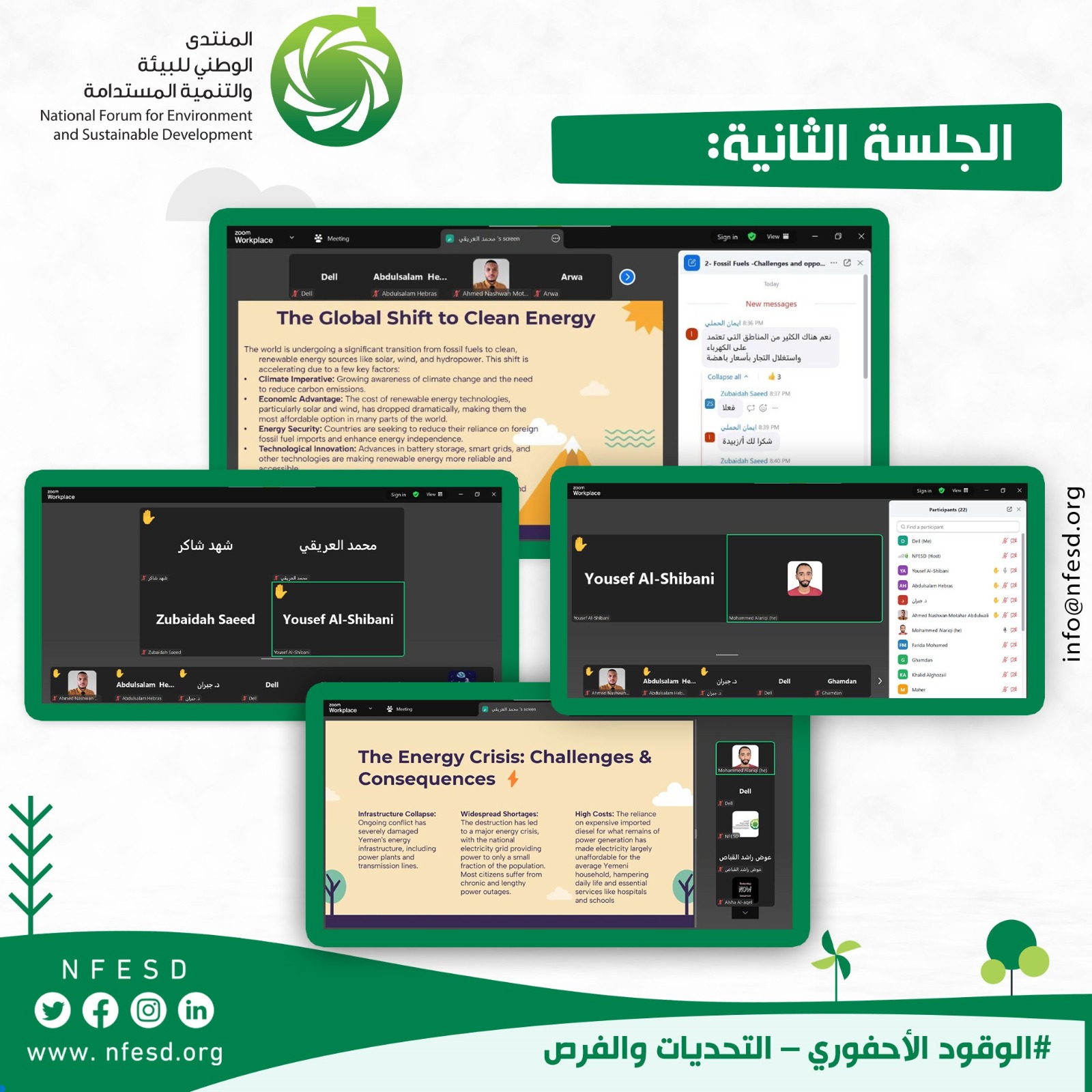
As part of its scientific educational program, “Understanding Fossil Fuels and Energy Transition,” the NFESD organized the second awareness workshop under the title “Fossil Fuels: Challenges and Opportunities.”
Engineer Mohammed Al-ariqi, the Energy Program Coordinator at the National Forum for Environment and Sustainable Development, gave a talk about Yemen’s significant dependence on fossil fuels. He emphasized the critical need for the country to switch to clean energy sources.
Engineer Al-ariqi began the session by explaining the nature of fossil fuels—oil, gas, and coal—as hydrocarbons that have powered global economies for decades. He emphasized that in Yemen, “the hydrocarbon sector has historically generated up to 80% of government revenue and most export earnings,” a dependence that has made the country highly vulnerable to both global oil price fluctuations and internal political instability.
He went on to describe the scale of the energy crisis facing Yemen, noting that “ongoing conflict has severely damaged the country’s power infrastructure, leaving only a small fraction of the population connected to the national grid.” As a result, most families, hospitals, and schools experience chronic power outages and are forced to rely on costly imported diesel, pushing electricity beyond the reach of the average household.
The discussion also explored the environmental impacts of fossil fuel dependency in Yemen. Engineer Al-ariqi stressed that leaks and spills from damaged infrastructure contaminate fertile soil and groundwater, while oil spills threaten the Red Sea’s fragile marine ecosystems, including coral reefs and fisheries. He added that “the flaring of natural gas at well sites continues to release harmful greenhouse gases, directly contributing to climate change.”
Engineer Al-ariqi provided an overview of extraction methods in Yemen, explaining how onshore drilling is concentrated in basins such as Marib-Jawf, Masila, and Shabwa, and how oil is transported through pipelines to export terminals on the Red Sea and Gulf of Aden. He also mentioned the long-standing use of Floating Storage and Offloading (FSO) systems, such as the FSO Safer, which has posed major environmental risks.
A key focus of the session was the global energy transition toward renewable sources such as solar and wind. Engineer Al-ariqi explained that falling costs and technological advances are making renewables the most viable solution, highlighting that for Yemen, “the global shift to clean energy is not just a trend; it is a lifeline and a path to recovery.”
He also underlined Yemen’s unique opportunities, stating: “With exceptionally high solar irradiation and strong wind potential, especially in coastal and mountainous areas, Yemen has the resources to build a resilient and decentralized clean energy sector.” He emphasized that off-grid solar systems already provide a practical model, as households and small businesses across different governorates have begun adopting them to meet their daily needs.
Engineer Mohammed further noted that a balanced approach is required: “Yemen cannot replace its fossil fuel dependency overnight. Phased implementation is needed—bridging the gap with temporary solutions while steadily expanding decentralized renewable systems.” He stressed the importance of supporting local businesses that import solar technology and investing in training programs to empower youth with the skills required for installation and maintenance.
The webinar concluded with a rich discussion among participants, who reflected on how renewable energy could help rebuild Yemen’s energy sector from the ground up, create jobs, and support vital services such as healthcare and agriculture. Many agreed that investing in clean energy across the governorates would not only address the current crisis but also lay the foundation for a sustainable future.
Participants also emphasized an important point for the private sector: investors in clean energy must carefully study the local terrain and conditions of each governorate to avoid costly failures. This call for context-based planning was seen as critical to ensuring that renewable energy projects in Yemen achieve lasting impact.
