
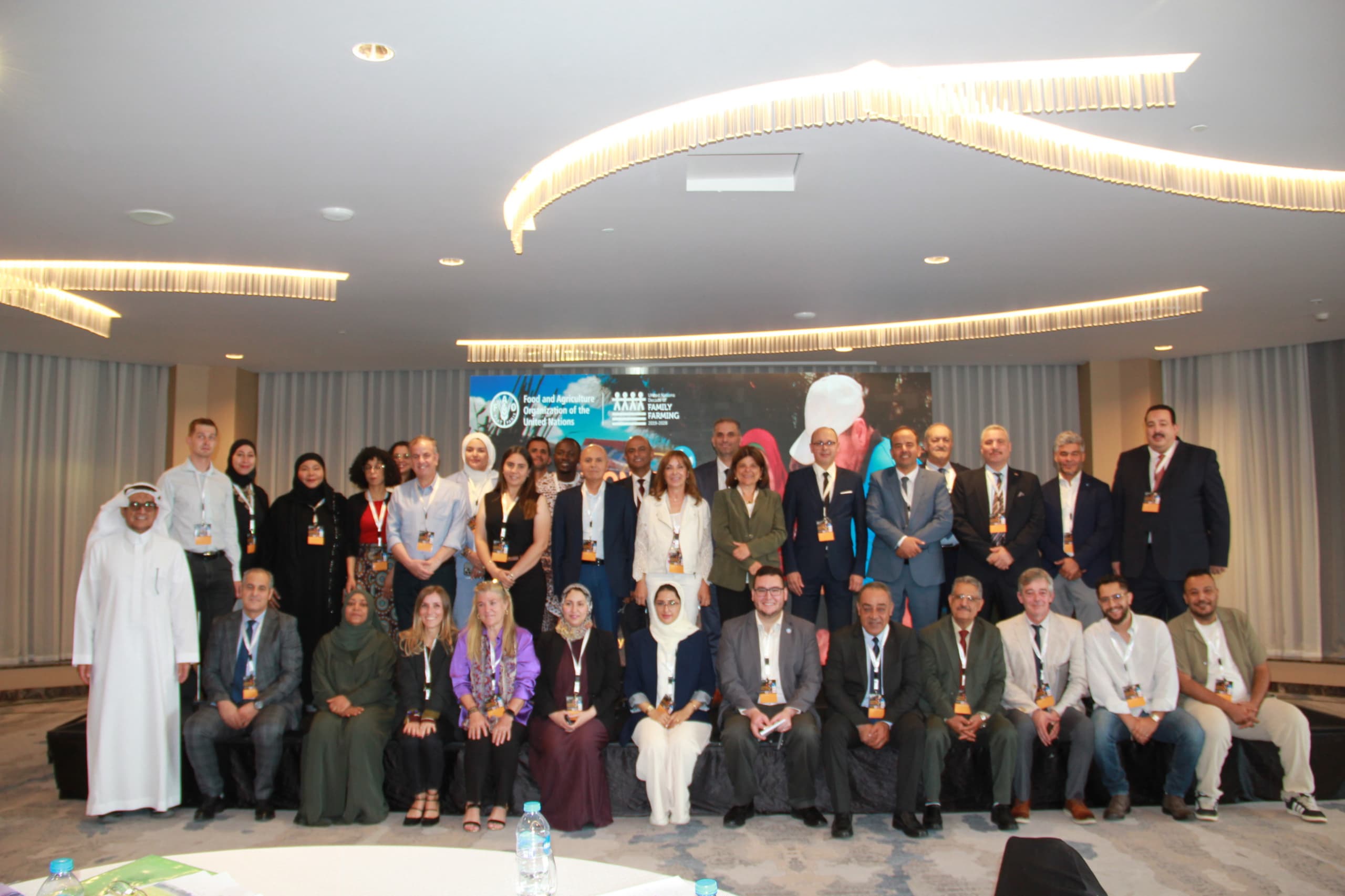

The UN Decade of Family Farming Interregional Dialogue Meeting
The Regional Workshop on Innovation and Sustainability in Family Farming brought stakeholders from the Near East and North Africa (NENA) and Latin America and Caribbean (LAC) regions. It was organized within the framework of the United Nations Decade of Family Farming (UNDFF), focusing on exchange of information, developing policy frameworks, and innovating practices that would make family farming more resilient and sustainable.
Workshop Highlights
After completing all of the registrations, Mr. Abdulhakim Elwaer (ADG/RR, RNE), Maximo Torero (FAO RLC Representative, online), and Ada Francisca de Asis Hernandez Rivera (Ambassador via video message) all supported the opening session by providing crucial remarks on the importance and unique value of family farming in regard to achieving sustainable development goals at all levels. Following that, Mr. Guilherme Brady and Ms. Dalia Abulfotuh who provided a comprehensive overview of the global and regional frameworks guiding the UNDFF, thereby establishing a solid policy foundation for the workshop’s discussions.
In a later panel, representatives from Tunisia and MERCOSUR were invited to analyze some innovation regions policies and sustainability approaches with respect to agriculture, exposing innovations made in particular regions and focusing on sustainability approaches. Later, all participants joined breakout sessions with the aim of defining major challenges and focal areas that impact family farming in their regions, enabling active and inclusive exchange. On the thematic round tables, the first was on digital tools where practitioners talked about Lebanon’s Farmer Registry and agribusiness platforms in Egypt, showing how technology can improve productivity and farmer participation. In the session on access to credit and other financial services, participants discussed government-based models from Morocco, Saudi Arabia, and Brazil which offer comprehensive rural financial inclusion strategies.
The second day of the workshop focused on climate resilience and agroecology. Emphasizing the role of secure land ownership and fair distribution of natural resources, experts pointed out how they enable climate-smart agriculture. Another group session focused on market access and novel business models; the State of Palestine, Morocco, and some Latin American countries were showcased for smallholder-inclusive urban agriculture cooperatives and their innovative value chain integration.
In the last part of the workshop, participants were self-assigned regionally inspired projects across four themes in hopes of informing the next Global Forum on Family Farming. In their final remarks, FAO representatives from headquarters and the regions strengthened the common resolve to convert workshop discussions into tangible, practical steps strategies that advance actionable workshop outcomes.
